Wednesday, 28 July 2010

BLOG 19

If you are visiting the blog for the first time, you will see that there are 3 sections to each entry. Life Before Quilting documents my early years up until the time I started to quilt. My Quilting Journey covers my 25 years of teaching and the quilts that I have made during that period. Quilting 2010 addresses what’s happening in my quilting life now. Just enjoy what you are interested in and visit often!

LIFE BEFORE QUILTING

The Tautunu made 3 stops to deliver much needed supplies to the local population, to collect copra and to enable Holland and myself to supervise the entrance exams. We called at Onotua, Tabituea South and Tabituea North and the sight of these islands was so welcome to me as a respite from bouts of seasickness. The ship could only get so far into the lagoons of these islands so the remainder of the journey had to be made by motor launch and often by wading. Whole villages would turn out to witness the arrival of the ship, the unloading of the cargo and the slow progress of transferring the passengers to the shore. As the only Imatang (white person) I was heavily scrutinised and commented upon! But I only recalled their happy, ever-smiling faces, scant clothing and the warmth of their usual greeting ‘Ko Na Mauri’.
Before the ship returned to Tarawa, we had to call in at Nonouti to collect copra, so Holland and I went ashore and called at his cousin’s house for an impromptu meal of rice and fresh fish, baked on an open fire.


QUILTING 2010

At the moment, I am concentrating on my contribution to ‘Pennants for Patch workers’. This is a money-raising scheme for the Quilters’ Guild, to be run as a tombola at the Festival of Quilts. As members we are invited to make pennants, to A4 size, in whatever style takes our fancy. I have used experimental pieces, left over from workshops, to make mine.


Pennant 1


Pennant 2

Pennants 1, 2 and 3 have machine-pieced backgrounds, with fused appliqué. Pennants 4 and 5 are machine-embroidered pictures. Some need to be bordered but they will be finished today and in the post tomorrow.


Pennant 3

Pennant 4
Pennant 5

Wednesday, 14 July 2010

BLOG 18


If you are visiting the blog for the first time, you will see that there are 3 sections to each entry. Life Before Quilting documents my early years up until the time I started to quilt. My Quilting Journey covers my 25 years of teaching and the quilts that I have made during that period. Quilting 2010 addresses what’s happening in my quilting life now. Just enjoy what you are interested in and visit often!

LIFE BEFORE QUILTING

Two months after arriving on Tarawa, and being the most dispensable member of staff (debatable!), I was despatched on a trip to the outer islands with an Ellice island teacher called Holland Banaba. Our task was to supervise the entrance exam on three outer islands for the boarding school where I taught. The ship was scheduled to call in at a fourth island to collect copra. I thought this would be a great adventure and I relished the opportunity to go. That was before I saw the size of the supply vessels that travelled between the islands. Known as T ships, the Temauri and Tautunu were smaller than the Lake District pleasure cruisers. They were shallow draft so that they could manoeuvre into the lagoons and get as close to shore as possible. I recall that accommodation was basic, with two compact first-class cabins on deck for travelling officials (us), two second-class cabins below deck, and deck accommodation for the remainder of the passengers who shared the space with their pigs, chickens and belongings.
Filled with a sense of responsibility for the task ahead, I settled down on the topmost deck of the Tautunu, ready to enjoy my first Pacific voyage. I watched Tarawa slowly recede and disappear over the horizon as we left the protection of its small harbour at Betio. As I resolutely turned to look ahead, I privately assessed the sturdiness of this small vessel against the vastness of the Pacific Ocean. Once outside the protection of the reef, it didn’t take long before the Tautunu settled into its corkscrewing rhythm. I believe I managed one meal before I disappeared into my cabin for the remainder of the heaving journey!


MY QUILTING JOURNEY

With my first quilt, Jacobean Spring, I always maintained that I started at the top and worked my way down for the rest of my creative career! As champion, I was invited to John Lewis’s in London, where my quilt was displayed, to demonstrate my technique in a remote corner of the basement. I also demonstrated in the waterways museum at Camden Lock, to advertise the waterways theme for the next year’s competition.

Having had success with the Jacobean style, I felt compelled to follow it up with another in the same style thus creating a series of work. The fact that the next quilt was called ‘Goodbye Crewel World’ said it all! The inspiration for this quilt was an antique, crewel wall hanging seen in a window display at Voirrey Embroidery on the Wirral. The hanging had originally been made at the Lee's Brother factory in Birkenhead, where young women were painstakingly trained to make exquisite hand embroideries, to be exported all over the world.
I was given permission to photograph and trace the flowers, motifs and stems as the inspiration for a quilt. I recorded the colours faithfully and, once back in my workroom, I simplified everything for ease of sewing. Here is the result:


Goodbye Crewel World 82” x 97” 1989
Hand appliqué, corded quilting and hand quilting

*This large quilt was the first one that I hand quilted as a complete quilt. It was rolled on a huge quilting frame which was placed behind the settee in the lounge and that's where I had to join it, whenever I worked on it! I never worked on that large frame again and have always preferred to hand quilt with large hoop from then on.
Below are some details of the quilt:


Goodbye Crewel World: detail 1


Goodbye Crewel World: detail 2


Goodbye Crewel World: detail 3


Goodbye Crewel World: label

Goodbye Crewel World: corded quilting


QUILTING 2010

I continue to make my Liberty Logs sampler quilt. It is a slow process as the pattern is so small and each square of a 16-patch block takes much attention to detail.


Liberty Logs: 16-patch with ruler

Above you can see the latest 6 ½” square against a ruler. Below you can see three paper patterns against small embroidery scissors. The squares are constructed using the paper foundation method, a process that revolutionised the precision in patch several years ago. I love it!


Liberty Logs: paper pattern and scissors

Sunday, 27 June 2010

BLOG 17

If you are visiting the blog for the first time, you will see that there are 3 sections to each entry. Life Before Quilting documents my early years up until the time I started to quilt. My Quilting Journey covers my 25 years of teaching and the quilts that I have made during that period. Quilting 2010 addresses what’s happening in my quilting life now. Just enjoy what you are interested in and visit often!


LIFE BEFORE QUILTING 1970

Formal classes at the school on Tarawa were scheduled for the mornings, the coolest time of the day. After lunch, there was a compulsory rest period for the children and this was followed by organised activities for an hour before the evening meal.
The PE lessons usually took the form of playing games, mainly volleyball, softball and tennis and the pupils were the keenest I have ever known. The pitches, on hard packed coral, were marked out, regularly I might add!, with lines of the whiter coral sand carried from the waterside. There were regular inter-house competitions played during the activity sessions and a sports day held once a year. (My greatest dilemma then was to mark out a full size and accurate running track, using white sand to mark the lanes!) As a teacher, usually wearing tennis whites and sunglasses, I taught technique, organised teams and umpired the matches.
I also had to teach classes at the Tarawa Teachers College (TTC) where students from 18 to 40 were being trained as teachers for the primary schools on the outlying island. Although we played the usual games, I was also interested to learn about local games.


MY QUILTING JOURNEY 1986


Jacobean Spring 62” x 78”

Jacobean Spring was my first competition entry, way back in 1986. The event was held at Audley End in Northamptonshire and the Marquis of Bath presented the prizes. My quilt was voted the winner of the hand appliqué section and was then selected as the over-all Championship Quilt! Imagine my surprise and delight. I had started at the top … and I have managed to work my way down over the next 20 years! For my efforts I was awarded 4 pairs of Wilkinson Sword scissors: dressmaking, embroidery, snips and pinking shears (not the sewing machine that is awarded nowadays!). I must also say that, way back then, this quilt was fresh, original and different. It wouldn’t win any prizes in today's competitions where availability of fabric, expertise in technique and innovation in design are far superior. But in 1986 I was proud to be National Patchwork Champion!


Championship prize 1986

QUILTING 2010

In Blog 10, I referred to my Alston teaching sample, seen below. This has been hanging on my wall since March, waiting for an excuse to complete it. That excuse has just arrived in the form of the Gresford Craft Show. This has been held every June for the last 30 years in the beautiful village church. The building, beautiful in its own right, makes a majestic gallery and many crafts are represented. You can see beading, felting, knitting, crochet, embroidery, painting, card making and quilting. This year Wrexham Flower Group is represented and there is a charming display of miniature rooms. There are plants to buy, a tombola, a sales table, refreshments and Dot with her ‘Quilting Basics’ stall. What more could a girl want?
I decided to complete the wall hanging that I started at Alston Hall in March. As I have plenty of Irises out at the moment in the garden, they were an obvious choice for inspiration.


Alston teaching sample


Iris wall hanging 11 ½” x 35”


Iris detail 1

Iris detail 2
The pinked scissors I won in the National Patchwork Championship in 1986 have come into their own now, as I use them regularly when constructing these painterly hangings. The fused fabrics are bonded onto the prepared background, and I have to do a lot of textured stitching to hold down the strips and small pieces in place.

Thursday, 17 June 2010

BLOG 16

If you are visiting the blog for the first time, you will see that there are 3 sections to each entry. Life Before Quilting documents my early years up until the time I started to quilt. My Quilting Journey covers my 25 years of teaching and the quilts that I have made during that period. Quilting 2010 addresses what’s happening in my quilting life now. Just enjoy what you are interested in and visit often!

LIFE BEFORE QUILTING

Life on Tarawa, the main island in the Gilbert Islands group, was certainly different from anything I had ever known before! Land consisted of a strip of compressed coral, no more than about 6 to 12 feet above sea level. This tiny strip of land was so narrow in places that it was possible to throw a stone into the ocean on one side and the lagoon on the other. There was only 12 miles of hard packed coral on the south side of the atoll that could loosely be called a road and, although a few cars had started to appear, bicycles and motorbikes were the main mode of transport. The remainder of the island, stretching to the north of the 100 square mile lagoon, was broken into smaller uninhabited islands by tidal channels but it was possible to walk and wade to the Catholic mission school of Taborio if necessary. The mission was mainly accessed by boat. Coconut palms accentuated the shaped of the atoll and gave welcome shelter from the searing rays of the tropical sun. This same sun rose in the morning at 6am and switched off dramatically some 12 hours later as it disappeared over the horizon.

MY QUILTING JOURNEY

The hand appliquéd and hand quilted sections of what became known as Jacobean Spring progressed steadily, in between my regular classes and travelling workshops. After 10 weeks of intensive work it was sent off unwanted, unloved and uninsured to the National Patchwork Championships. Quite frankly, with the intensity of work I had seen enough of it and was glad to see the back of it!

‘Only 10 weeks!’ I hear you gasp. It was at this time that I started to learn how to save as much time for my sewing as possible:-
I taught my daughters how to cook: Tin opener: can. Can: tin opener!
I only ironed the front of my husband’s shirts in the sure faith that he just didn’t look at the backs.
I realised that if ‘stuff’ was put back where it belonged, it produced an aura of orderliness.
I sprayed polish into the air just before my husband came home so he would assume that I had been polishing.
I have always been told by my husband that I never put things away after I used them so all I had to do was leave out the polish and duster or the Hoover and he would just assume that I had used it!

What a game but at least the quilt was finished quickly!


Jacobean Spring Detail 1


Jacobean Spring Detail 2


QUILTING 2010

Little progress has been made quilt-wise due to a trip to London where we attended a practice for the Trooping of the Colour. We watched the Colonel’s Review with the Duke of Edinburgh officiating - a practice for the Queen’s Birthday Parade the following weekend. The 1st Battalion of the Grenadier Guards was trooping its Colour this year having recently returned from Afghanistan in April. Regimental flags were historically known as ‘colours’ because they displayed the colours and insignia worn by the soldiers of different units. The principal role of a regiment’s colours was to provide a rallying point for the troops in the chaos of war and so it was necessary to display them through the ranks of troops. This is the origin of the word ‘trooping’.

The spectacular event, in the welcome June sunshine, was an impressive mix of striking red and black uniforms, precision marching and manoeuvrings and pulse-stirring music. What I shall remember most, and what you don’t pick up when you watch the even on television, is the rhythmical crunch of the over-polished boots on the loose gravel of the parade ground. Nor will I forget the gleaming coats of the high stepping horses as they passed proudly and spiritedly before us. Absolutely great!

Saturday, 29 May 2010

BLOG 15

If you are visiting the blog for the first time, you will see that there are 3 sections to each entry. Life Before Quilting documents my early years up until the time I started to quilt. My Quilting Journey covers my 25 years of teaching and the quilts that I have made during that period. Quilting 2010 addresses what’s happening in my quilting life now. Just enjoy what you are interested in and visit often!


LIFE BEFORE QUILTING

I was met at Tarawa International Airport, (a tiny building made of local materials), by the acting Head Mistress and a couple of teachers and whisked off to the house where I would live for the next 2 ½ years. It was a functional breezeblock dwelling, C grade and posh by standards, with wooden shutters and an unkempt pandanus roof. Situated on the ocean side of the island, it nestled comfortably in white coral sand, about 20 yards away from the fluid boundary of the high tides. At low tide, I looked out on a ledge of hard packed coral sand, edged and protected from the relentless pounding of the waves by the visible reef. At high tide, the Pacific Ocean stretched away endlessly to the horizon, with the submerged reef defined only by the waves curling and breaking over it. The sand was white, the sky mainly blue and cloudless and I was surrounded by pandanus trees and coconuts palms.
My job was to be responsible for the PE throughout the boarding school for the girls and the boys: EBS (Elaine Bernacchi School for girls) and KGV (King George the Fifth school for boys). And I was launched straight into it, over-lapping for just a few weeks with the departing New Zealand volunteer, and left to get on with it. I couldn’t have been happier!


MY QUILTING JOURNEY

So I was determined to make my first quilt for a competition in hand appliqué, made in smaller sections and joined together after it was quilted, but what subject? I really started to ‘look’ for the first time, to open my eyes to design possibilities and one of things I witnessed was my mother sewing a Jacobean motif in cross stitch. Interesting, I thought.

I went to the local library and started to research theses distinctive floral designs, to take photocopies and to make simplified drawings. I saw the Jacobean style simply as a stem rising from the earth, winding its way up the fabric, throwing off exotic flowers and leaves as it went. Plenty of artistic licence here I thought!

I chose a simple palette of fabrics and made 4 repeated corner motifs (see Jacobean corner motif below). I reviewed them on completion and realised that there was no real impact and that something lacking. So I ‘auditioned’ a variety of colours and discovered that it was a cornflower blue next door to the terracotta that enhanced the palette of fabrics. That was the accent colour I needed to give the ‘pow’ factor (see Jacobean motif below).
So, another valuable lesson learned, colour was a very important aspect of quilt making. Not only did I need a palette of compatible fabrics I needed small scraps of an accent fabric to enliven them.


Jacobean corner motif


Jacobean motif


QUILTING 2010

Most of my present time, in between gardening, is taken up with quilting the Prancing Horse wall hanging. It is bulky under the sewing machine and requires constant rolling, folding, twisting and turning. This makes it physically challenging but the reward is to see the horse emerging in stitch on the back. The horse is being scribbled in thread, the tail in free-flowing lines and the background in wavy lines following the lines of the strips on the front. This copious stitching helps to hold down the bonded fabric on the right side and define a secondary picture of the wrong side. Much more work is needed to complete it ready for exhibition.

Horse in stitches

Monday, 17 May 2010

BLOG 14

If you are visiting the blog for the first time, you will see that there are 3 sections to each entry. Life Before Quilting documents my early years up until the time I started to quilt. My Quilting Journey covers my 25 years of teaching and the quilts that I have made during that period. Quilting 2010 addresses what’s happening in my quilting life now. Just enjoy what you are interested in and visit often!


LIFE BEFORE QUILTING

So there I was at 21, recently qualified as a teacher, and standing on a coral atoll called Tarawa, in the middle of the South Pacific. There was a wearying 36-hour journey behind me, and a 2-year contract ahead of me. I had one suitcase with all my worldly belongings, a collection of postcards (to share with them the wonders of the outside world) and a melodica (which I couldn’t play!)

From high in the air, I had seen the whole island as a tiny pinnacle of coral surrounded and protected by a reef, not unlike a tiny blob of paint seeping into the endless azure blue of the Pacific Ocean. On closer inspection, it revealed itself as an L-shaped strip of coral planted with coconut trees, enclosing a lagoon and surrounded by a reef. On landing, all I was aware of was white coral sand, coconut trees and I felt the intense tropical heat of the fierce afternoon sun. The simple sign saying ‘Tarawa International Airport’ was proudly fixed onto a locally constructed structure made from the ribs of coconut leaves and topped with a roof of pandanus leaves. I had arrived!


MY QUILTING JOURNEY

At this stage in my journey, in 1985, I had started home-based classes and the word is spreading. Periodically I would do a one-day workshop with a 3-course lunch to spread the quilting messages wider than my immediate classes. I heard about a craft class in Gresford and started to go there when I was free from teaching (regular readers may recall the mention of one of my current projects: the Gresford sampler) I also joined Chester Ps & Qs (Patch workers and Quiters) so that I could get to know a wider circle of quilters.
I worked hard to be enthusiastic when I taught any technique for the umpteenth time and I coaxed students along week by week in classes. But I needed to develop my skills too. It was about this time that I heard of the National Patchwork Championships. As one who needs to work to a deadline, I decided to enter my first quilt, Appliqué Sampler, of which I was justifiably proud.


Appliqué Sampler


I ran this idea across a ‘friend’ who said the organisers were looking for something a bit more special than that! After recovering from the unintentional hurt of the comment, I wondered what to make instead. I genuinely thought that ‘special’ meant that I had to design something new so I started to look around for an idea and I fretted about what I was capable of achieving. I knew it had to be hand appliqué because this was all I could do well at this stage and the quilt had to be worked in smaller sections to be joined after it was quilted.


QUIILTING 2010

My main focus at present is to get the horse wall hanging machine quilted now. I have thought about this process on and off during the last few days of its construction but apart from the fact that it has to be machine sewn because of the bonded fabric, nothing definite had been decided. I chose to put plain black fabric onto the back so that the quilting with coloured threads could be seen and appreciated as a picture in its own right.


Horse detail 1


Horse detail 2

Thursday, 6 May 2010

BLOG 13

If you are visiting the blog for the first time, you will see that there are 3 sections to each entry. Life Before Quilting documents my early years up until the time I started to quilt. My Quilting Journey covers my 25 years of teaching and the quilts that I have made during that period. Quilting 2010 addresses what’s happening in my quilting life now. Just enjoy what you are interested in and visit often!

LIFE BEFORE QUILTING

My initial VSO destination was to have been Mauritius but some problem arose with that posting during my final days at college, forcing me to rapidly apply for jobs for the coming September (1970). I left college to go to a school in Stafford where I filled in for 3 weeks for a PE teacher who was on maternity leave. I half-heartedly attended a couple of interviews in schools in the Midlands but then I was contacted by UNA International Services (a branch of the British Volunteer Programme) and asked it I was willing to go to the Gilbert and Ellice Islands Colony (GEIC) in September. Not half I thought! I posted my acceptance letter, looked on the map to see just where these islands actually where and then told my parents of my intention. I can vividly recall the conversation now:
"Hello Mam, I’ve got a job."
"Oh lovely dear! Is it the one in Leamington Spa or are you staying in Stafford?"
"No, I’m going to Tarawa."
"Tarawa dear? Which county is that in?"
"Actually it’s in the middle of the South Pacific!"
At this point I hear the phone clunk and my mother shouting ‘Dick, come and talk to your daughter!’
And where was my destination? I had to fly from London to New York, then to Los Angeles for a flight to Hawaii and on to Fiji. The Gilbert and Ellice islands (now called Kiribati and Tuvalu since independence) are located vertically north from Fiji, where the International Date Line crosses the Equator. If I had gone any further, I would have been coming back home!

MY QUILTING JOURNEY

So, just to recap, there I was in 1984 in Sychdyn (Soughton in English), N Wales, with a husband travelling to and fro to Bootle daily and 2 daughters at the village school next door to the house…..and still pondering what to do career-wise! It’s fair to say that we had a lot to do to get the house in order but there was plenty of space for creativity.
There was an extra lounge along one side of the property and one day I stood in there and just wondered if I could get home-based classes running in that. I put my 3 quilts on display in a shop in our nearest market town of Mold, with a poster saying ‘If you can sew along a straight line, you can make these!’ I got so many enquiries that I was able to establish 3 classes immediately and over the next few years built up to 7 classes a week. That equated to 12 ladies per class, and 84 per week. I used to teach 3 classes on both Monday and Tuesday (10am – 12 noon, 1 – 3pm and 7 – 9pm), and the final class on Wednesday evening. I just loved it! As I began to stock and sell fabric and supplies, I nominated Thursdays as my ‘At Home’ day when quilters from miles around knew I was there for chat, coffee, fabric and advice. And that’s what I did for 20 years, fitting my own work in between the essential teaching samples.

Few people realise just how much conscientious teachers give up of themselves. They have to put their interests and creative needs on the back burner and devote time and technique to their students. Any particular technique I was interested in was filed in the recesses of my mind to be unwrapped when I had the time and space to attend to it.

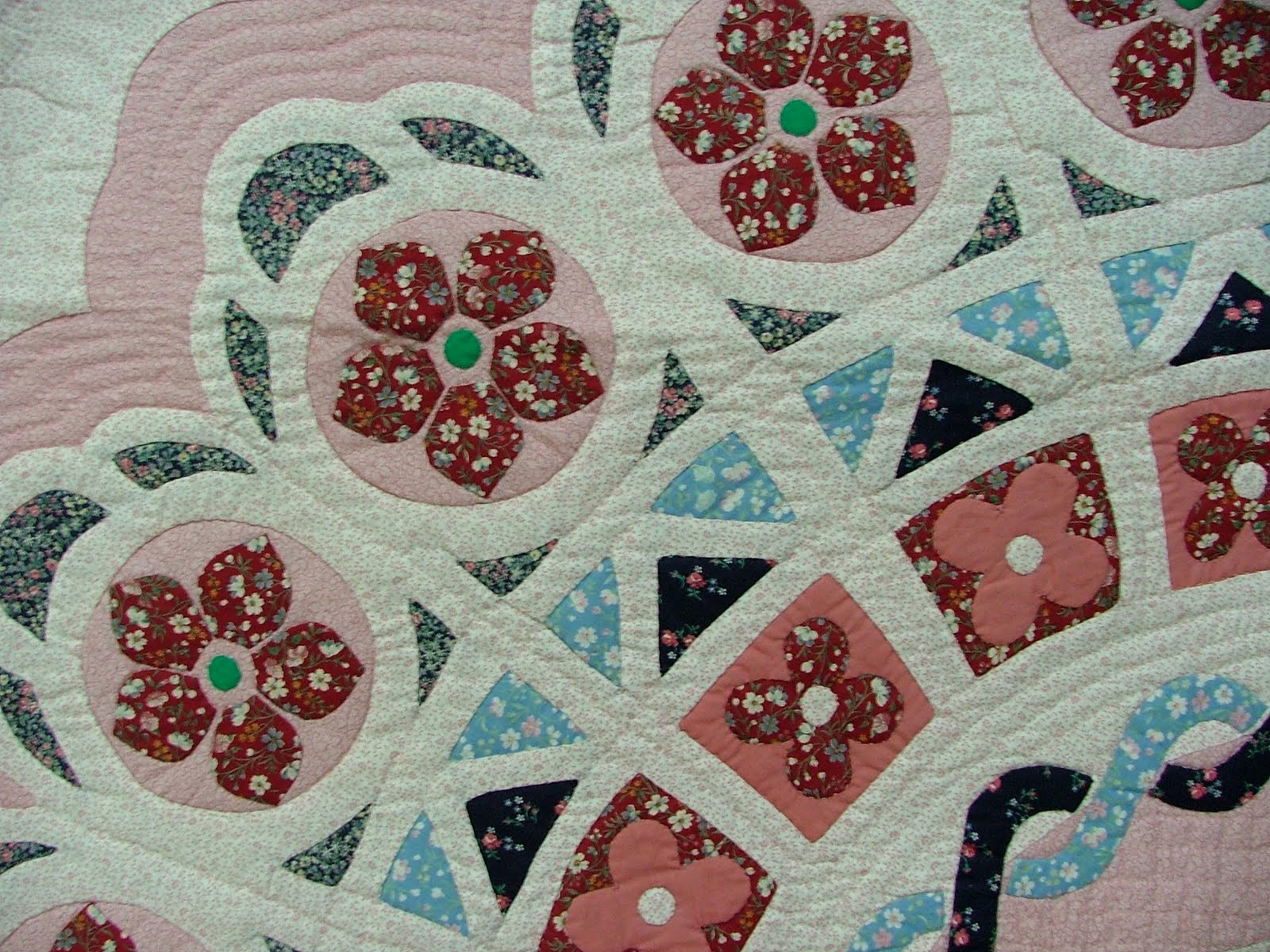
Here is a quilt from that early teaching period, inspired by a paper doyley and sewn using a hand reverse appliqué method and needle-turning technique.


Doyley Art


Doyley Art (detail)


QUILTING 2010

I have now managed to get my Prancing Horse picture together but it needs more fine-tuning before it is ready for the quilting process. It is often difficult to control the size of a hanging when you work freely as I do, so it is larger than I anticipated (famous last words). It just grew to fill the space! The fields around me are full of horses and ponies during the winter months so there is always plenty of visual inspiration. Add to that the resources of the Internet and pages of poster art and you can’t go wrong!
The wall hanging is made from squares of bonded fabric, each square being constructed with fabrics bonded on the diagonal to give a sense of movement. This part of the project is the problem solving, the part I particularly like. The next step is to place the picture onto wadding (batting) and a background ready for quilting. This will be done by machine.


Prancing Horse: unquilted


Prancing Horse: detail 1


Prancing Horse: detail 2