Sunday, 27 November 2011

BLOG 78


It’s that time when I have to come up with something interesting to say again. Many things happen in my life during the course of a week but when I started this blog, I made the decision to mainly talk about my quilting time. So, now that my mother has celebrated her 96th birthday and has passed the psychological barrier of out-living my father, I can turn down the fret level and concentrate on my own creative needs. She had a good report after her medical check up, so all’s well with my world!

Log cabin bag

The next stage is to quilt the 4 separate sections of the bag. Last week I showed a single strip but actually there are two different, repeated sections, which can be seen below.

Bag sections

The black corners add apparent complexity and detail to the log cabin design. Because

they are loose, they can be manipulated and this can be done before or after quilting.

The diagonal fold of the black fabric is on the bias of the fabric so this can be rolled

back to give the appearance of a curve.

Corners: before and after

Roll the fabric back along the fold to produce a curve andcatch it down with

a small stitch, in matching thread.

Place the sections onto batting (no backing) and pin ready for quilting.

Quilted section

I used walking foot and a stretch stitch (herring bone) to quilt around the squares and along the joining seams. Because the stitch swings from side to side, it is balanced equally over the seam. Quilt all the 4 sections in this way ready for construction next week.

Sometime soon our Meerkat quilt will be returned and then I will be able to write an article about it for a magazine, as well as post some detailed pictures on my blog. We did it for fun and it was such a surprise when it won the group section and Visitors’ Choice. It has been touring and on display at other shows and we look forward to seeing it again! This is the only picture I have of my meerkat as a work in progress.


Meerkat


Sunday, 20 November 2011

BLOG 77


Log Cabin bag

In Blogs 72 and 73, I demonstrated how to make a traditional log cabin block and I have to say that I personally prefer impact of the block with the added corners, known as ‘Geese in the Cabin’. So I have made all ten blocks like this. Press the blocks well and check that each one is the same size before continuing with the method.

Geese in the cabin

And here is the template needed for construction. It consists of 2 complete blocks and one half block. You will need one of these for preparing the batting pieces.

Template

There are 4 individually quilted sections to the bag and this is what the construction will look like eventually, showing the position of the complete blocks and half blocks.

Construction

In preparation for construction, 2 squares need to be divided across the centre like so.

Preparation

I have been trying out different layouts on a design wall, and this is the one I have chosen where the gold side of one square goes against the red side of another. All the geese fly away from the centre.

Layout

Having decided on the layout of the blocks, the next step is to join and quilt each of the 4 single units. And that’s what I will be doing this coming week.

Single unit

My husband, who posts my blog each week, always claims that he reads it with interest. This is to test to see if he does! We have been happily married for nearly 40 years and humour has been such an important part of our marriage. And when you look at this picture, you’ll see what I mean. Aw bless!

The cat and the man witha hat

Sunday, 13 November 2011

BLOG 76

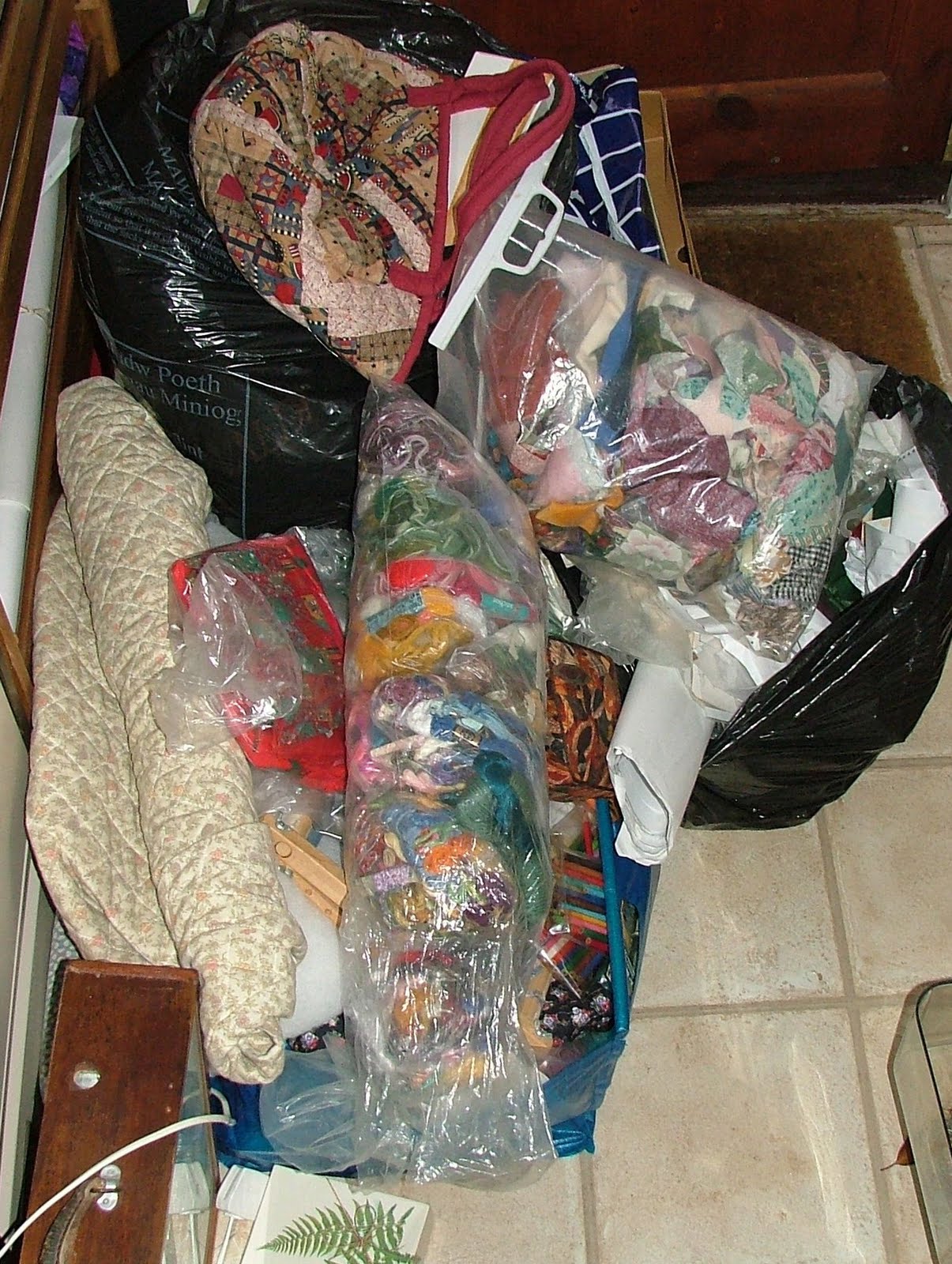
This week I had a sobering experience and I interpret it as a wake-up call. The daughter of a quilting friend who died 3 years ago contacted me. Audrey used to come to my home-based classes in the early days and was with me for many years. She was a great and enthusiastic fan of my work and was a capable and prolific needlewoman. She attempted most of the techniques that I demonstrated and went on to share them with her own quilting groups. She also helped with samples for some of my early books. Now that her husband is in a nursing home, the time has come for the family to clear out the house prior to selling it, and this is why I was contacted. The family have kept what was to be used and treasured and below is the ‘stuff’ that remains, after I have sorted and bagged it! I have agreed to try and sell it at the groups I attend to raise money for the Quilters’ Guild of the BI in Audrey’s memory.

Audrey’s ‘stuff’

Whilst sorting through her ‘stuff’, it quickly became evident that there was so much of myself passing before my eyes. There were folders of my workshop notes, some of my early patterns and trial samples that Audrey had made and all I could think about was that this was what my own daughters would have to face at some (hopefully very, very distant) future date. It has been quite an experience and it has made me determined to organise and catalogue what is important to me as ‘Dilys the quilt’. And I am equally determined to discard and streamline my own quilting paraphernalia. I think it may help to concentrate my mind and energy on what I really want to create.

Liberated Appliqué: I have managed to complete the fused appliqué sample that I demonstrated last week.

Liberated appliqué

I quilted along the cut lines with a herringbone stitch and doodled a flower design overlapping the centre square with free-motion machine stitching.

Quilting design

I don’t really think that it would be a good technique for making quilts that are used and laundered. But for spontaneous and speedy wall quilt construction, it is liberating as the title implies. The only downside is that the wadding can sometimes be seen between the cut edges where the fit isn’t precise enough. In this instance a layer of dark batting or a false layer of fabric could be used to solve that problem.

Floral wall hanging: The floral wall hanging has been developing very slowly indeed but here are the latest pics.

Floral wall hanging 1

Floral wall hanging 2

Floral wall hanging 3

Wednesday, 9 November 2011

BLOG 75


Another late blog! In my defence, we have been without telephone connection for several days now, thus affecting the Internet and email connection. Early last week there was an accident on a nearby lane, when a car ran into the telephone pole and brought down all the lines. No one was hurt fortunately but we have been without connection for the last 10 days. They assured us that we would be on again by last WE, but ours certainly wasn’t connected. And those that were, all the wires were crossed so that when you rang one number, you got another!

All in all, this has been quite a thought provoking experience, highlighting just how reliant we are on technology these days. We have been using our mobile phones for necessary contact but, as we don’t get a good signal in our rural environment, those contacts are hit and miss. So, on the whole, it has been quiet and tranquil here and what you don’t know, you don’t worry about!

I’d like to say that I have been sewing furiously but I haven’t. I visited my mother and stayed for a couple of nights to see how she is getting and to keep her company. Although she is frail and her mobility very poor, she fights on!

Liberated Appliqué

Here is an interesting exercise that we tried at the last Chester Ps&Qs meeting. We were asked to bring along a cutter, board and ruler, as well as batting and a backing. We prepared squares of fabric (e.g. 4”) by ironing a fusible web onto the back. I just happened to choose a colourful, stripped Batik fabric.

Fused squares

From each square, we were then instructed to cut out a smaller square to leave a border (e.g. 1”). We repeated this on the smaller square and ended up with 3 (or 4) shapes separate units.

Cut out squares

When we had cut out 16 squares in the same way, we shuffled the shapes about and put them back together again.

Repositioned squares

And that’s all there is to the preparation! The squares were then place side by side onto cotton batting (it must be cotton) and they were ironed to fuse them in place.

Fused squares

Now isn’t that just cool!! Obviously there are raw edges that need securing but a bit of decorating stitching or free motion machining helps to secure them onto the batting. I fuse straight onto the batting with my painterly method so this was an extension on that technique. I loved it.

Monday, 31 October 2011

BLOG 74


I am slightly later than usual in posting my blog as I have been at the Autumn Quilt Festival in Malvern. I had a lovely time with everything going like clockwork. Unusually, the motorways ran freely and I was able to remember the route to the show ground from last year. I stayed in a clean but functional Travel Lodge in the centre Worcester, shopped for food at Marks and Spencer and spent my evenings reading, drawing and watching tv .. I believe it’s called chilling out.

Here are some of the quilts that formed part of my display.

Landscapes

Wallhangings

Archway quilts

Prancing horse

Still life on the tiles

Cat and Balusters

The quilts were not hung to their advantage because of the hanging systems that are used but I was proud to see them there and delighted with the public response to them. I was berated often for not having written a book about the method yet … perhaps I feel another book coming on!

Sunday, 23 October 2011

BLOG 73


The method of sewing log cabin squares for the bag project has been demonstrated at Gresford craft group this week. I showed the strip piecing method and Jennifer demonstrated the foundation method. (I DIGRESS: When quilters told me that their preferred method of sewing was ‘The Foundation Method’, I always thought that it sounded a bit like a contraceptive. As it is a fail safe method, you can justifiable claim that you practice safe patchwork with it!)

Anyway, after all the preparation, I am happy to say that there is a lot of interest. Having seen the original bag (Blog 73) with the added corners, some wanted to give that a try. It requires a bit of extra preparation but it is a simple procedure.
For each block, cut 6 squares at 2 ½” from the fabric used for the centre. Iron them in half to create a triangle.


Corner squares

Add the first round of logs to the centre square and then pin the corners in place. Use 1/8” seam along the raw edge to baste them in place before adding the second round of logs.


Round 1 + corners


Round 2


Pin and baste the next corners in place.


Round 2 + corners

Add the third round of logs and baste the corners in place to complete the block.


Round 3 + corners

For the bag, you will need 10 identical blocks.

In preparation for constructing the bag, you will need to make a cardboard template like the one below. It is 7 ½” wide (the size of the block) and divided into 2 squares and a triangle. Along the long side, the first square measures 7 ¼” The block less one seam allowance), the second 7” (the block less 2 seam allowances) and the third 7 ½”.


Cardboard template

My blog may be late next weekend as I will be at the Malvern Autumn Quilt Festival, where there will be a selection of my painterly quilts. I will be demonstrating my Dual Image method, selling my Christmas patterns and books, and running a daily mini workshop. Come and say hello if you are there.

Sunday, 16 October 2011

BLOG 72

I have managed to frame my four pictures and I am really pleased with the results. They are ready for putting into the exhibition at the end of the month and it will be the first time I have ever exhibited paintings and offered them for sale.

Small paintings

Large paintings

I will not see them hanging, as I will be at the Autumn Quilt Festival at the Three Counties Showground in Malvern. Running from Friday 28th to Sunday 30th October, this event promises to be inspirational. There will be many different exhibits within the show and I will be showing, for the first time, a body of work called The Fabric Palette. I will be there to run a mini-workshop daily, to sit behind my stall and demonstrate and to sell my latest book and my collection of Christmas patterns. Come and say hello to me!

Next Tuesday, at the Gresford craft group, a friend and I are starting another project for those in the group who want to join us. This time, our theme is based on the traditional block of log cabin. I am going to start with a simpler version of the bag shown below and I have started to prepare my demonstration if you are interested to have a go.

Log cabin bag

The pattern, for reference, is based on a 7” square and you can draw it easily on a sheet of graph paper as shown below. Mark a 1” square for the centre and 1” logs around the outer edge. Number the sewing sequence and shade the dark side.

Log cabin pattern

The centre is a 1 ½” square and the fabric strips are cut at 1 ½”. Set up your machine with a neutral thread and attach a ¼” foot. This is the basic block. It starts with a centre square (black). Row 1: 2 gold strips and 3 red strips are sewn in sequence (I worked clockwise) round the centre block to complete the square again. Row 2: repeat the sequence. Row 3: repeat. Now what’s complex about that? Accurate cutting and sewing is essential and I recommend the use of an iron throughout the process. More next time.

Log cabin sequence